
Housing Noise
Different Layers, Different Solutions

It’s never one simple thing. In anything.
The housing situation in America is no exception. In fact, it’s deeper and wider than I understood it to be….and boy is it noisy.

I was sitting in a housing conference up at UNC Chapel Hill last week. It’s an amazing initiative called ncIMPACT that is put on by the School of Government. This particular program was called Carolina Across 100 Our State, Our Homes. It was an 18 month journey to help communities develop capacity, analyze challenges, and implement strategies to address affordable housing and related issues across the state.
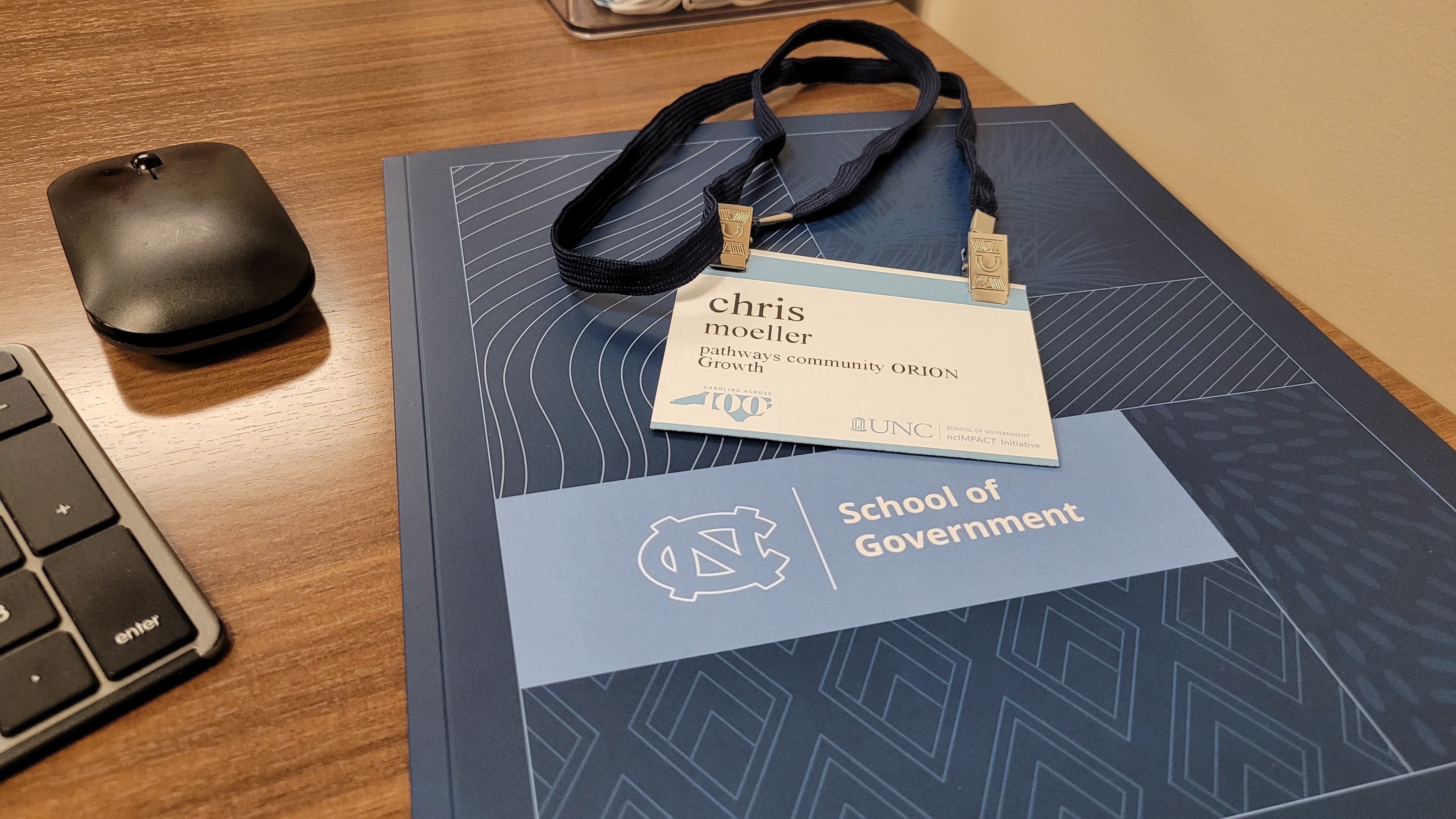
Think County Commissioners, Town Managers, Planners and staff. It was very helpful for me to understand where North Carolina stands within our national models for upward mobility and age-in-place.
I kept hearing ‘affordable housing’ getting tossed into the mix with ‘workforce’ housing. On top of that, I kept hearing the Low-Income Housing Tax Credit (LIHTC) get tossed into the mix with market-rate development. To confuse things even more, people were talking about national builders developing large tracts of rural land to support urban sprawl.
It was a housing salad.
So as I was sitting there listening and taking notes, I typed a simple prompt into one of our housing LLM’s and out came this image:
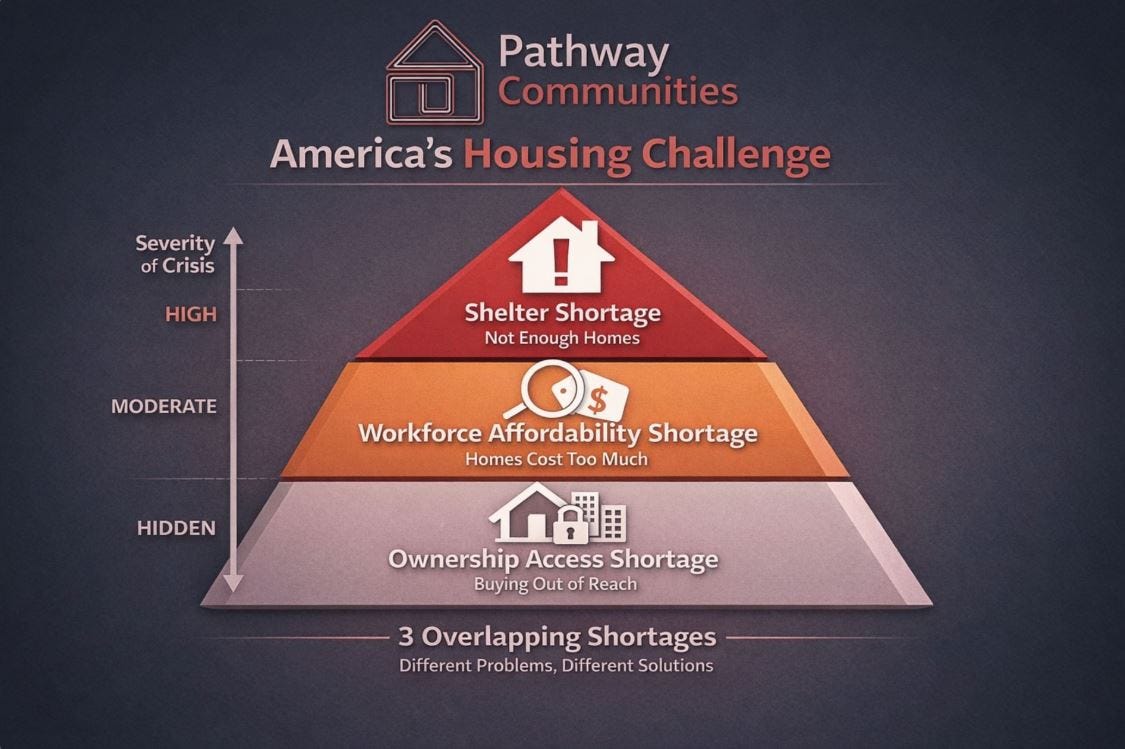
What struck me most was not just the categories themselves, but the structure. This wasn’t one housing problem. It was three overlapping shortages, each with a different level of visibility, urgency, and consequence. Different problems, different solutions.
The first thing I found interesting is that it was framed as a ‘challenge’ which I like. I like building and solving, so this was perfect to tinker with.
The next thing I appreciated was its shape. A mountain with the peak being illustrated in red and indicating urgency. That top tier is physiological. Like -Maslow’s needs physiological - right there with food, water, and clothing. The image calls this ‘shelter’ and it was aptly labeled ‘Shelter Shortage’ as in, not enough.
Inventory.
We do not have enough basic, physiological shelter in the United States.

I talked with Jeremy and Mark over at Thinking on Paper in the early days about this.
Here’s the statement I’m using that helps keep this (very important) initiative standing on its own.
“We have a critically low inventory of stable shelter in the United States.”
To me, this is where the acronyms of state and federal assistance enter the chat.
AMI, LIHTC, HUD, LMI, PHA, PBV, JTX - even RFP and RFQ.
About $64 billion a year in major HUD housing programs alone, before adding tax credits and some broader community-development programs. In FY2025, HUD’s enacted funding included about $36.0B for Tenant-Based Rental Assistance, $16.9B for Project-Based Rental Assistance, $8.81B for Public Housing, $1.25B for HOME, $931M for Section 202 senior housing, and $257M for Section 811 housing for people with disabilities. (source: HUD.gov)
If you also count the Low-Income Housing Tax Credit, which is the biggest federal affordable housing tool, the Fed’s expenditure is is about $15B (source: US Department of Treasury).
So, like, $80B if we don’t get creative an add in CDBG for community development.
This is not my area of expertise. To keep on brand with the housing word salad of acronyms….this is my TAM, but not my SAM or my SOM….and not at all my ICP.
This is important work, but it’s not what we’re trying to do with our Pathway Communities.
Let’s come down the mountain a little bit. The atmosphere and severity of high-crisis mode has me out of breath.
As we move through the housing challenge image and descend into workforce affordability, we start to pick up a bit more of a mellow vibe. This is where people love to roost. Not quite a crisis and some inherent balance - so nobody is getting hot and bothered.
Be prepared to hear A LOT of noise around workforce housing.
Why?
Economics.
The basic, physiological shelter doesn’t pencil. Yep, you read that right.
$80B of funding and somehow it doesn’t pencil.
👆 A separate article, err, expose so I’ll ✋ and leave you with two words: soft & cost.
Workforce housing is now being washed like so many other important objectives:
Greenwashing, Wokewashing, Healthwashing, Proteins, Regenerative, Wellness…the list goes on.
This is why words matter.
The phrase “housing crisis” is useful, but incomplete. It suggests a singular event. What we actually have is a layered system failure: visible at the top, structural at the bottom, overlapping all the way through. Different problems, different solutions.
We can fix this.
I was watching a segment this weekend on Anduril founder Palmer Luckey, and he said something that stuck with me. His point, in essence, was that too many contractors can stretch process endlessly, modify the contract to death, and still get paid while the public absorbs the cost.
That feels familiar.
Luckey’s model, controversial or not, was to build with conviction first, use his own capital, and create a working product instead of waiting for the perfect process to bless the outcome.
He turned process into product.
That line stayed with me because it points to something much bigger than defense tech.
It points to housing.
In housing, we have become extraordinarily good at managing process. We study it, regulate it, finance it, delay it, subsidize it, commission it, and debate it. But process, by itself, does not create enough durable, attainable places for people to live.
That is where I believe we need a different approach.
We are turning process into product too.
But we won’t stop there.
Once we have the product, we intend to turn it into a technology, something that learns, improves, and drives cost down over time instead of pushing cost up over time.
That is the part that matters most to me.
Because the future of housing cannot just be about delivering one project at a time with more friction, more consultants, and more cost stacked into the system. It has to become more repeatable, more intelligent, and more durable.
That’s right.
A housing model that drives costs down over time.
Not through compromise…not through cheapening the product.
Through better systems, better learning loops, and better alignment between what we build, how we build, and who we build it for.
We privatize the issue. We don’t ask for more money from Washington.
What we are facing is not one housing problem. It is a stack of housing problems. Shelter shortage is one thing. Workforce affordability is another. Ownership, mobility, and long-term stability are another thing entirely. Different layers, different economics, different solutions. If we keep treating them as interchangeable, we will keep applying the wrong tools to the wrong problems.
That is why I am so interested in building a housing model that does more than add units. I want to help build a system that can learn, repeat, improve, and drive cost down over time. Not just because America needs more housing, but because people need more stability.
That is the work in front of us, not simply to build homes, but to build the communities for people to move forward.
Explorers use compasses, not maps.