
Looking Back
...so we can look forward.

A reflection is temporary. We can’t sit still, but in order to look forward, we have to look back. This is my year in review. It’ll only take a few minutes. In fact, its only 3 things and they’re observations, not predictions.
#1 Get comfortable with being wrong.
I looked back through a whole year of my LinkedIn posts. Going back exactly 365 days. This one from Brad Hargraves stuck out for me:
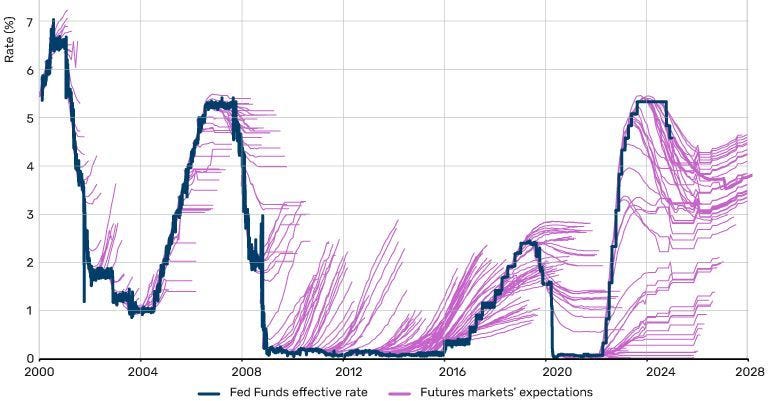
“The chart that proves no one can predict real estate's future (including me).
Look at this chart for 10 seconds.
What do you see?
Those purple lines represent market predictions for interest rates.
The blue line? Reality.
And here's the truth: We've been wrong for an entire decade.
Let that sink in:
• Every purple line shows what experts predicted
• The blue line shows what actually happened
• The gap between them? Billions in miscalculated real estate investments
Here's why this matters: Interest rates make or break real estate deals.
They're the foundation of:
• Every pro forma
• Every valuation
• Every investment decision
Yet this chart tells us that we're all just guessing.
So next time you're sweating over the 10-year Treasury sitting above 4%, remember this:
The market has always been confident about where rates are headed.
And the market has always been wrong.”
In a binary world, it’s very hard to be wrong and still succeed. This proves there is much, much more nuance to markets and systems than we are taught. For example, we’re aren’t taught to embrace failure and learn from it to make us stronger. We simply didn’t win. But not winning for a whole season just teaches us that we had a shitty season…if the coaches don’t break down why.
We can’t improve that which we have not measured.
Collection systems (and the methodology behind the information) are not created equal.
What am I getting at? We need to clearly delineate between ‘tried-and-true’ and ‘data driven’ insights. Personally, I’m way more worried about the data-driven side than I am the historical side because people don’t YET have a relationship with data - let alone an intimate understanding of it. That’s cross-generational. Boomers might believe it because they saw it on the news or read it in a magazine. GenX probably read it in a study online. Millennials take a blended social approach. They all have merit and value, but greatly miss the point:
“Who is the authority and how did they get their information.?”
Policymakers and executives alike call for data (as if they’re calling on High) to help inform (persuade, influence, and support) their decisions.
This used to come in form of using ‘the best’ or the ‘biggest’ option simply to cover one’s ass if (when) the project hit a pothole.
There are layers upon layers in the world of wrong. Get used to it. We’re about to learn that a ton of things we always thought were right are actually wrong. Look no further than the desperate rise of the corporate storyteller.
Takeaway:
Progress no longer comes from being right, it comes from understanding WHY we were wrong, questioning who defines truth, and learning to work with uncertainty instead of hiding behind data or history.
#2 Listen, don’t talk. Then think.
I’ve learned so much from so many epic human beings this year - Ray Dalio, Jordi Visser, R. Buckminster Fuller, The Long Now Foundation, Will Harris, Joel Salatin, Brad Hargraves, Paul Stanton, Dror Poleg, Brian Elliot, Paul Hawken, Rick Rubin, Kevin Kelly, Reading on Paper, Packy McCormick, Kelly Colón, Aaron Lubeck, Gabe Brown, Rob Avis, Mitch Rawlyk, Susan Rogers, Lisa Whited, Ram Srinivisan, Margaret Wheatley and so many more…..
But the pattern isn’t found in the people themselves, the pattern is found in their work. Emerging Economics, Time, Regenerative Agriculture, Food Systems, Work Systems, Emerging Assets, Creativity, Exploration, Energy, Neuroaffirmation, Housing, Emerging Technology and Philosophy. These are my people and their field of study. There is no blueprint. No roadmap. In fact, there’s barely a field guide to what these folks are working on, let alone a simple ‘data-point’ that helps generate a graph to ‘sell’ someone on an idea.
This is about observing, thinking, and then acting.
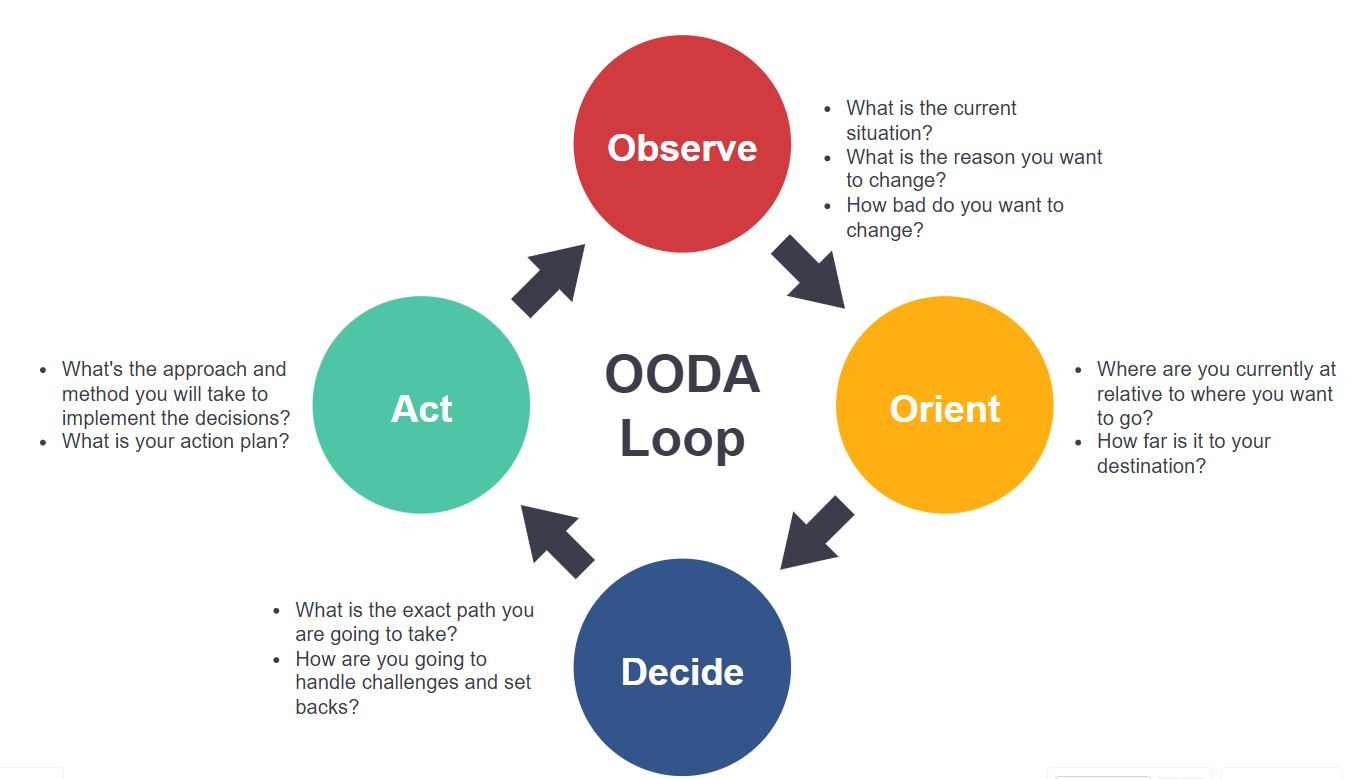
Colonel John Boyd was a fighter pilot and Pentagon consultant during the second half of the 20th Century. One of his nicknames was ‘Forty Second Boyd’ for his standing bet as an instructor pilot that beginning from a position of disadvantage, he could defeat any opposing pilot in air combat maneuvering in less than 40 seconds. This later became the energy-maneuverability theory (E-M theory) of aerial combat and ultimately, the OODA Loop. Side Fact: Boyd was said to have stolen the IBM 704 computer time needed to do the millions of calculations necessary to prove the theory.
The Loop explains how agility can overcome raw power in dealing with human opponents.
Here’s a simple loop diagram:
Here’s the USMC’s version:
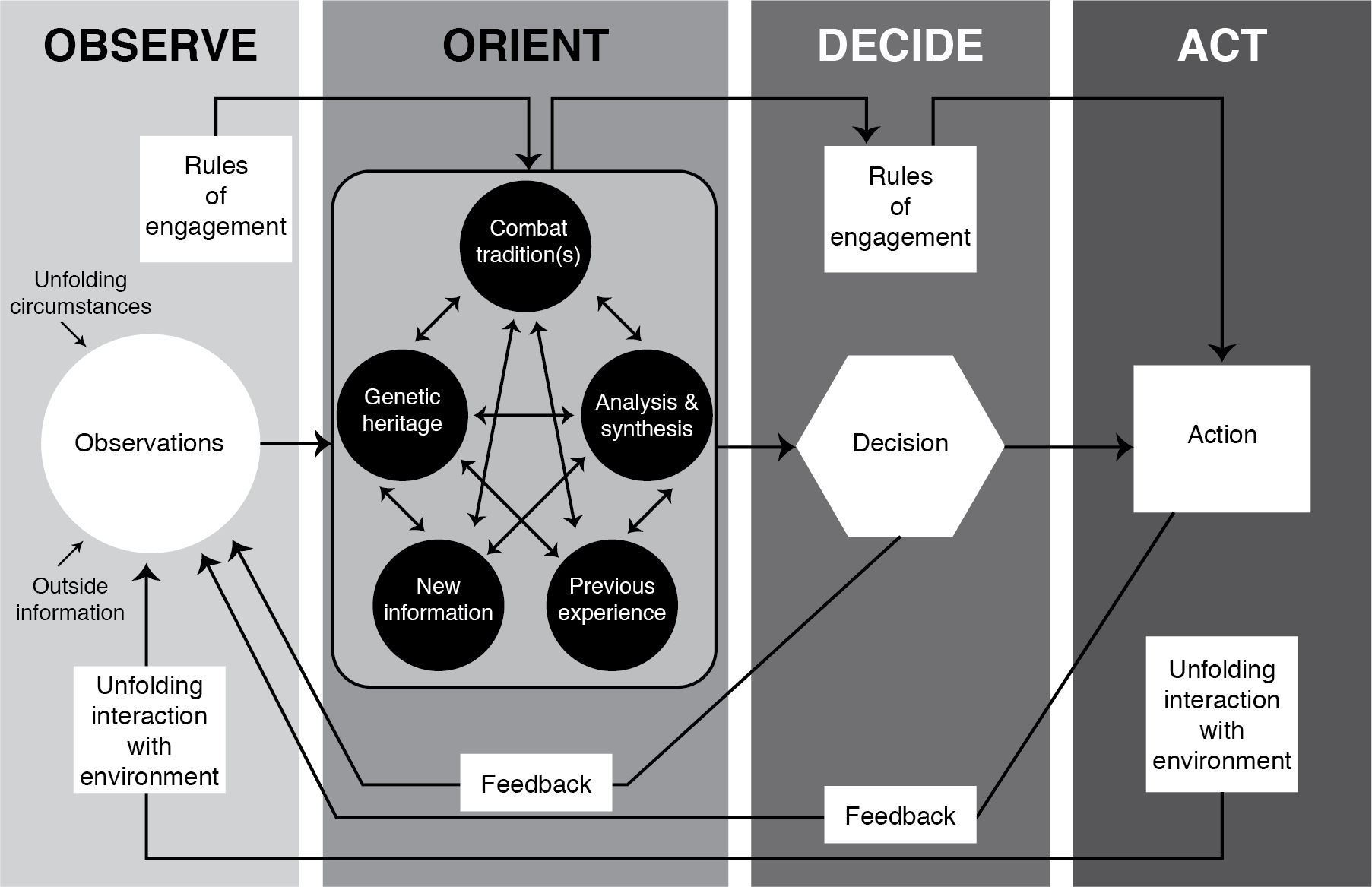
It always starts with observation. As humans, our eyes and ears are connected directly to our brains. Look and listen first - and let it process. We have amazing cognitive speed, and the ability to see and hear so many more things than we are aware of. Our pupils dilate, increasing retinal light which optimizes visual performance and sensory responsiveness. Our brain shifts to “active'“ (Cortical State Shift) which desynchronizes cortical activity and makes the brain more sensitive to incoming information.
You can follow the diagrams above to take you through the loop, but there’s a missing ingredient in the images. In his theory of conflict, Boyd highlights the psychological and temporal aspects of war and argues that one can paralyze an enemy by operating inside his OODA loop. This can be accomplished by ‘tightening’ friendly OODA loops and/or ‘loosening’ enemy OODA loops. He calls this the Theory of Strategic Paralysis.
This is the human side of conflict. This is where we go when we want to understand People over Platform, or Place. This is where Rhetoric lives. Philosophy, Sociology, Psychology. Boyd refers to the three-dimensional being consisting of ‘moral-mental-physical bastions, connection,
Takeaway:
Real advantage doesn’t come from having the loudest voice or the cleanest data, but from observing deeply, slowing the impulse to speak, and thinking long enough to act inside complexity rather than reacting to it.
#3 Build anyway, for humans & for time.
The only option that really ISN’T an option is waiting. This is why we have workshops and labs. We have to tinker. We have to reTHINK the way we build.
Building anyway doesn’t mean forcing growth. Economics still apply and maybe more so now than any other time in my career. Energy matters. Getting in over our heads, financially or operationally, is not regenerative, it’s extractive — it’s also ubiquitous in business right now. Contracts are skewed, materials costs are astronomical, skilled labor is at an all-time low. Most of what we used to do, doesn’t pencil. That doesn’t mean do it anyway. That means get a new pad, sharpen the pencil, and rethink the formula. Nature doesn’t overextend without consequence, and neither can we.
If there’s one thing I’ve learned from watching things grow at the farm, it’s that emergence doesn’t come from scale or certainty. It comes from interaction, feedback and restraint. From trying small things in real conditions and letting what works compound over time. Small wins, with consistency. Timing is everything. Seed, soil, moisture, temperature, sunlight. Living systems don’t grow from perfection, but nor do they grow (or sustain) from recklessness. But here’s the key - we have to do the work.

I like to think that recognizing ‘good enough’ is a virtue, not a compromise. It shows our alignment with reality - not a distorted view of mechanized perfection. But there’s a huge difference between getting something started and getting something perfect. Right now, we have to get things started.
Takeaway:
Building anyway means respecting economics, honoring human limits, and trusting emergence over perfection.
Summing up ‘looking back’
So….
Get comfortable with being wrong.
Listen, don’t talk. Then think.
Build anyway.
I guess to me, this reflection back on 2025 doesn’t leave me with a checklist or a roadmap or a strategy for next year. It feels more like a posture or an orientation. It serves as reminder that we can (and must) move through uncertainty without freezing or pretending we know more than we do. I said it a lot this year - explorers use compasses, not maps…and that theme will continue well into next year. Personally, I’ll be avoiding anything that proclaims “simple steps” or “proven methods” in 2026.
I’m less interested in predictions and more interested in practices. Maybe we could all benefit from being less focused on being right and more focused on being useful? Perhaps that might change our perspective on scale and make us more in tune with finding the right fit.
Onward and Upward, but always Forward.
#TinyGiants
Happy end of 2025. I’ll be back next year.